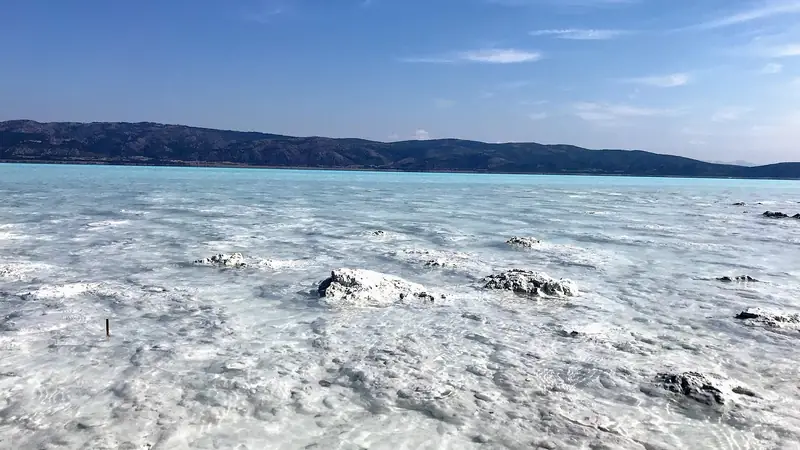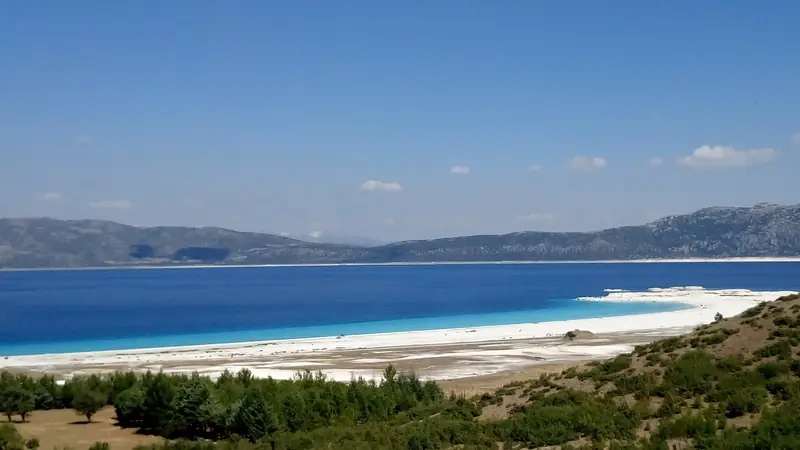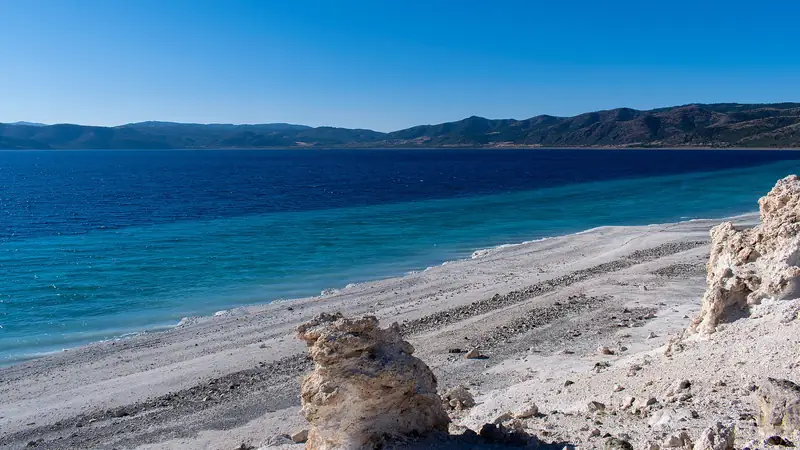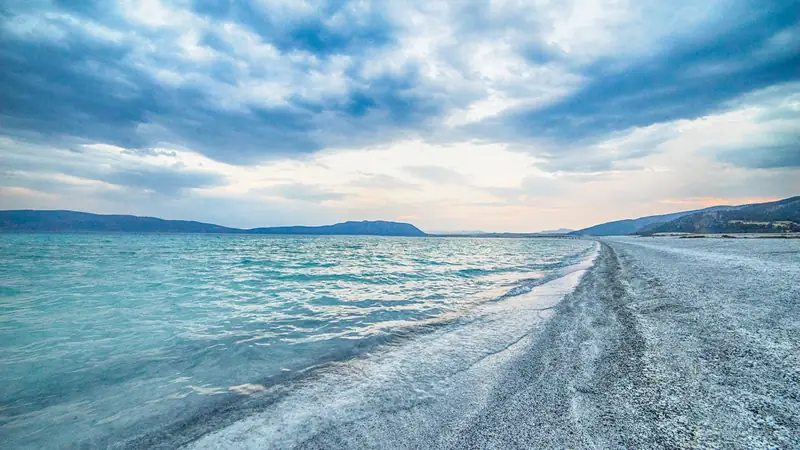
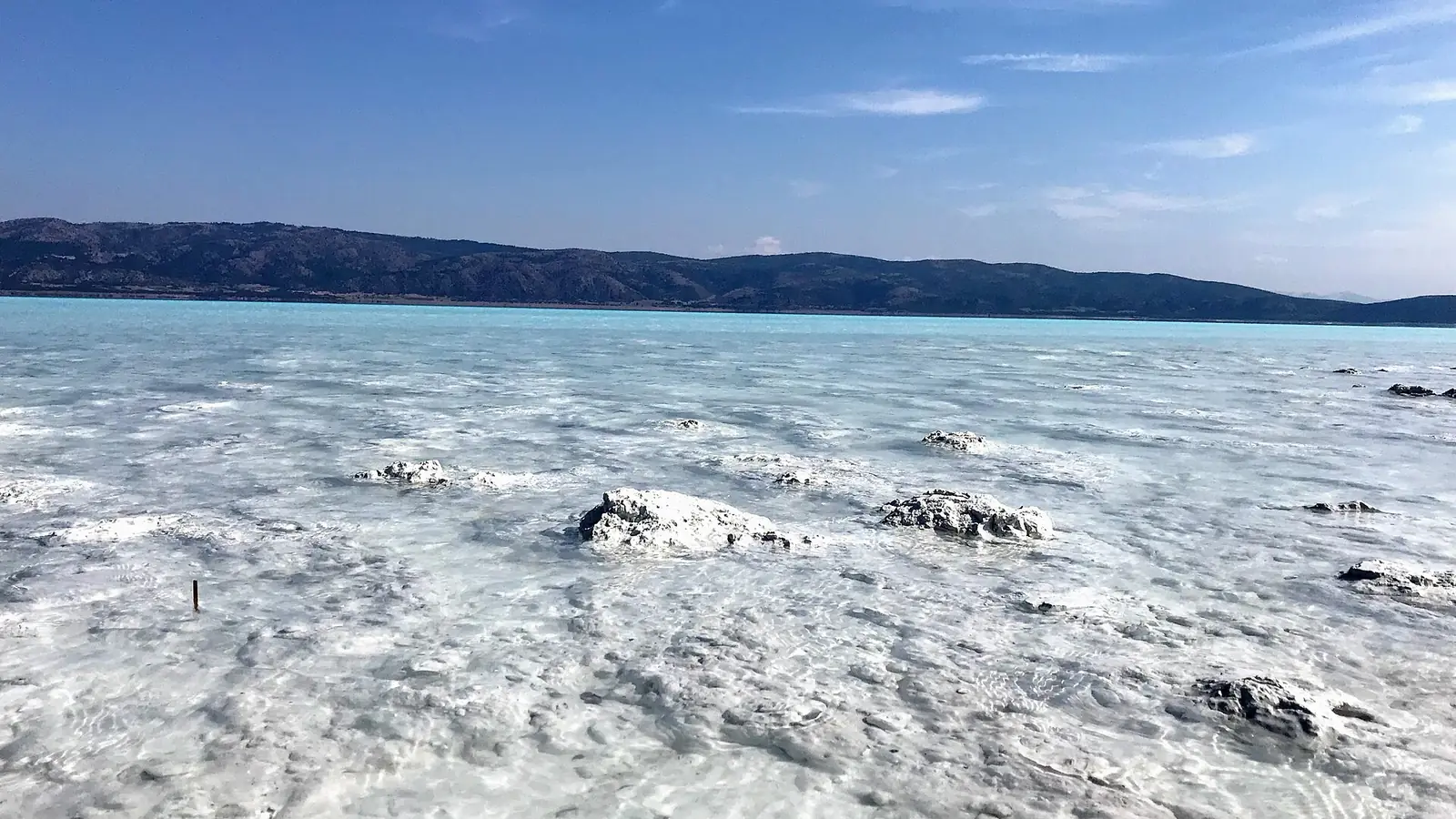
Visitors expect a white lake and find turquoise water with a white edge. The turquoise comes from shallow, clear water over the pale hydromagnesite bottom, which scatters and reflects blue-green light back up. The edge is the interesting part, and it is also the reason the rules are strict.
What the white material is
According to NASA’s Earth Observatory (February 2021), the white shoreline of Lake Salda is made of sands and gravels dominated by hydromagnesite, a hydrated magnesium carbonate. The lake water is rich in magnesium and highly alkaline: a 2025 conference abstract reports a pH of 9.0 to 9.3. It also describes modern hydromagnesite stromatolites forming in the lake. There, substances produced by bacteria and diatoms give the mineral a place to start growing.
The sediments are thought to have eroded from microbialites, layered rocks built with the help of microbes. That is why scientists treat them as a possible place to look for traces of ancient life.
The Mars connection
Researchers, including NASA-funded teams, treat Salda as one of the best-known Earth analogues for Jezero crater on Mars, where the Perseverance rover collects samples: it has carbonates and delta deposits like those found there. Mars orbiters had detected carbonate minerals along the western rim of Jezero, probably an ancient lake shore, and later Perseverance found mineral evidence of a lake there. Planetary scientist Briony Horgan of Purdue, a member of the Perseverance team, visited Salda with Istanbul Technical University colleagues in summer 2019, and said the work was helping decide which deposits on Mars are the most promising to visit.
A fair note: most coverage comes from 2020 and 2021, around the Mars landing; we did not find a post-landing paper that concerns Salda specifically. “Salda is Mars on Earth” is an analogy used by researchers, not a claim that the lake is a copy of Mars.
Why it matters for your visit
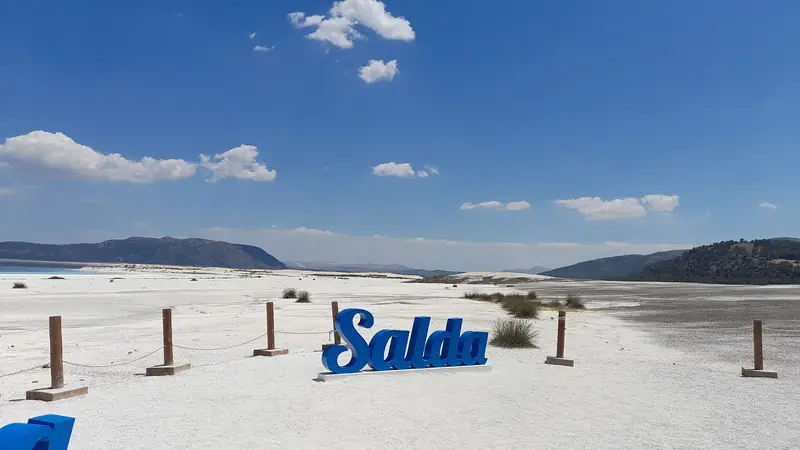
The white shore is a fragile deposit and a research subject. That is the logic behind the ban on entering the water and the sand in the White Islands area from October 2020, and why taking sand or stones is a finable offence (swimming rules). You can enjoy the colour from the shore; see the visiting guide for where to stand and the entrance fee page for practicalities.
Sources
- NASA Earth Observatory, “What a lake in Turkey can tell us about Mars” (17 February 2021).
- Live Science, “Lake Salda: the only place on Earth similar to Jezero crater on Mars”.
- EANA 2025 conference abstract on Salda stromatolites and extracellular polymeric substances.
If you want another white landscape in the same region, Pamukkale and Lake Salda can be done in a long day.
Frequently asked questions
Why is the sand at Lake Salda white?
It is dominated by hydromagnesite, a magnesium carbonate mineral, according to NASA's Earth Observatory. The sediments are thought to erode from microbialites, rocks formed with the help of microbes.
Is Lake Salda like Mars?
Researchers compare it to Jezero crater, where NASA's Perseverance rover works, because Salda has carbonate shorelines and delta deposits similar to those found there.
Is the water itself white?
No. The water is clear and looks blue-green. The white colour comes from the mineral shore and bottom sediments.
Some links are affiliate links: if you book through them we earn a small commission at no extra cost to you. It funds the research behind this site.